
Field Notes
23.07.26 · Budapest
Sziget for first-timers: the island festival, explained
// Annelies · 7 min read
Most festivals are a field you drive to. Sziget is an island in the middle of a capital city, and for one week in August it becomes one of the biggest of its kind in Europe. If it is your first, that changes how you plan it, and how it feels once you are on site.
Here is what it actually is, from people who spend the last four years in the pit.
What Sziget is
Sziget runs on Óbudai-sziget, an island in the Danube in the north of Budapest. 'Sziget' actually means island, we figured that out after 2 years (oops).
In 2026 the main days are 11 to 15 August, Tuesday to Saturday, with after-hours programming rolling into Sunday morning and a move-in day on Monday 10 August for camping ticket holders. That length matters. Sziget is not a weekend, it is close to a week, and it is built to be lived on rather than visited for an afternoon.
It calls itself the Island of Freedom, and the name is doing real work. This is not only a music festival. Between the stages there is theatre, circus, art installations, and whole corners of the island that have nothing to do with a headliner and everything to do with the atmosphere. You can have a full day here without watching a single band you planned to.
The 2026 bill runs from Twenty One Pilots, Florence and the Machine and Lewis Capaldi to Bring Me The Horizon, Zara Larsson, Jorja Smith, Underworld and Sombr. It is a wide spread on purpose. The line-up is only ever half the reason people come.
The Island of Freedom means it
That nickname has sharpened in recent years. Hungary's government has passed some of the harshest anti-LGBTQ+ laws in Europe, including a 2025 law that bans Pride events outright. Sziget has made a point of moving the other way: everyone is welcome on the island, and the programming says so out loud, with acts from every corner of the world and the Magic Mirror, the festival's LGBTQ+ venue, now running for two decades with music, cabaret and talks. When the government demanded that venue be closed to under-18s, the festival refused. Sziget takes no Hungarian government money, and it spends that independence on exactly this: the European Festival Awards have handed it the Take a Stand prize twice for it.
You notice it without reading a single statement. For one week, the island simply feels like the most open place in the country.
How it is different from a normal festival
Two things set it apart for a first-timer.
- The first is the city. Sziget sits inside Budapest, not an hour from anywhere. You can spend a morning in the thermal baths or the old town and be back on the island by the afternoon. A lot of people build their trip as a city break with a festival attached, or the other way round. That is a real option here in a way it is not at a festival stranded in a field.
- The second is the crowd. Sziget pulls one of the most international audiences of any European festival. You will hear more languages in a food queue here than at almost any other festival on the continent. If you are travelling alone or worried about knowing nobody, this is about the friendliest version of a big festival there is.
It is mixed in age, too. Groups of friends on their first festival, parents with kids on their shoulders (there is dedicated kids' programming on site), couples who look like they met here decades ago. And the island is big enough to hold both speeds: you can lose yourself completely in the noise, or find a quiet relaxing area and take your time. Nobody makes you choose.
Getting there and staying
The island is easy to reach without a car. The HÉV suburban railway line H5 runs from Batthyány tér and Margit híd every fifteen to twenty minutes, and the stop for the festival is Filatorigát. From central Budapest it is a short, cheap ride. You can also take one of those little e-scooters, or take a taxi. Good to know: the taxis are very well organised right outside the festival, even in the middle of the night.
On where to stay, the real choice is camping on the island or sleeping in the city. Camping puts you inside it: you wake up already there, and the site never fully stops. You will have a lot of fun, but you also will be very dusty. Staying in Budapest gives you a bed, a shower and a door that locks, at the cost of a train ride at the end of every night. Neither is wrong. It comes down if you will emerge yourself completely in the festival, or choose to also check out Budapest.
Tickets, in short
At the time of writing: a full five-day pass is €399, a three-day pass €279, and a single day €109, with camping from €129 for five nights on top (handling fees extra). There is a payment plan if you would rather spread the cost, and day tickets make it easy to sample the island if a week feels like a lot. Once you are in: download the official Sziget app, it carries the day-by-day stage times. And accessibility is properly organized through the festival's Accessible Sziget program.
What we see that you might miss
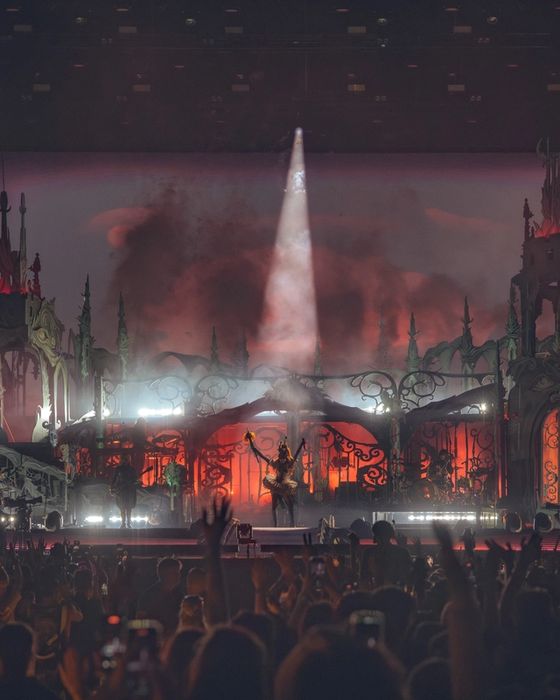
Ofcourse we shoot the main stages, but the parts of Sziget that stay with you are usually the ones between them. The smaller stages late at night. On of our favorite stages, where we spend a lot of time is DropYard. A stage dedicated to HipHop acts. The art installations that make no commercial sense and exist purely because someone wanted them there. The slow drift across the island at three in the morning when the big sets are done and the place softens.
First-timers tend to over-plan the headliners and under-plan the gaps. The gaps are where the island earns its name.
The honest part
It is August, in a river valley, and it gets hot. Long days, a lot of walking, sun with nowhere to hide in the middle of the site. Bring more water and more sun cover than you think you need, pace the early days so you are not wrecked by the weekend, and wear shoes you can stand in for fourteen hours. Bring some wipes so you can clean your face from the dust and take a little blanket so you can also sit down and chill out for a bit. None of that is a reason to skip it. It is the difference between surviving your first Sziget and actually enjoying it.
A word on safety, because first-timers always ask. In four editions of working this festival, we have never seen trouble, and the atmosphere stays friendly deep into the night. Bring the usual festival common sense, know where your people are, and Sziget is about as easy as a festival this size gets.
Five days, an island, one of the most mixed crowds in music, and a city you can step back into whenever the festival gets too big. For a first one, there are worse places to start. Or start with a daypass or 3 day ticket.
From this story
Also on TREACLE
Field Notes
Sziget 2026, Day -1 and Day 0: the year the festival got itself back
For the first time since 2017, Sziget belongs to the people who built it. You can hear it in what they programmed before the festival even opened.

Voices
Wild Wild Women: "If the hunger dies, you die"
India's first all-female hip-hop collective spent this summer on their most extensive European run yet, ending at Sziget. MC Mahila, one of the five, on how it started at a cypher in Mumbai, what it cost to get there, and why nobody in the group writes anybody else's verse.
Field Notes
ADE 2026: what a day actually looks like
The 30th Amsterdam Dance Event runs 21 to 25 October, from an aquarium at nine in the morning to hundreds of club nights. Here is the shape of a day.
TREACLE