
From the Pit
03.09.26 · Amsterdam
Shooting at Melkweg Amsterdam: A Photographer's Guide
// Coda · 8 min read
Why Melkweg matters for music photography in Amsterdam
Melkweg is the room we have shot in more than any other in Amsterdam. Not steadily, though. For a few years we lived between Berlin and Amsterdam, so it went in waves: some months we were in that building almost every week, then a long stretch where we were not in the country at all. Which is a useful thing to say out loud in a venue guide, because it means what follows is not a house photographer's account of a room they see every night. It is what the place looks like when you keep arriving back at it.
That we kept ending up there is not because Melkweg books the biggest names in the city. It is because it books the most. A former milk factory on the Lijnbaansgracht, one minute from Leidseplein, running several halls at once, most nights of the week. Raye played there in February 2023. 6lack, Dizzee Rascal, Renee Rapp, CMAT, Danny Brown, Jessie Murph, Larry June, Cobrah, Paul van Dyk, all in the same building on different nights.
Annelies was going to Melkweg years before she started shooting, and still goes on nights off, without a camera. That is worth saying up front in a guide aimed at photographers, because it is the reason this room is worth knowing in the first place. Whichever role you turn up in, it is a good place to be.
It is also worth knowing that Melkweg is not only a concert venue. It runs club nights and parties alongside the live programme, and the two feed each other. A room that was a seated listening show on Tuesday is a sweaty floor on Saturday. If you are used to venues with one fixed mode, this takes a show or two to read.
The layout: what to expect inside Melkweg
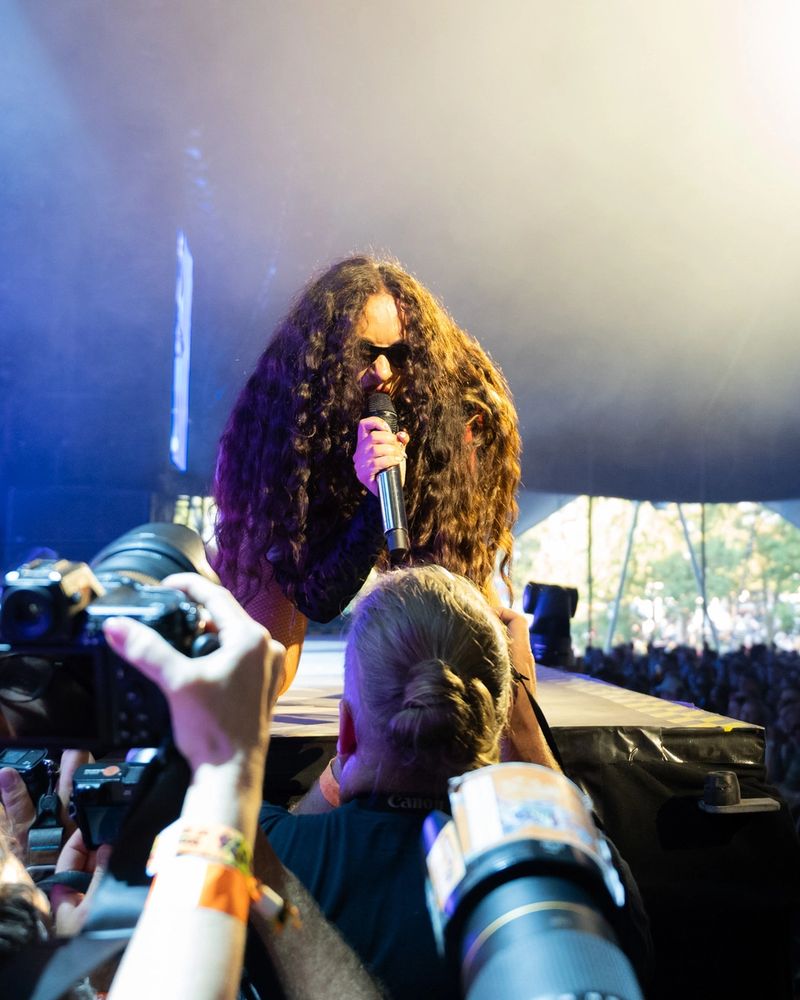
Start with the thing that shapes everything else. There is no photo pit. Not in the Max, not in the smaller halls. No barrier, no three-metre strip of floor between you and the stage. You shoot from inside the crowd, the same as everyone standing next to you.
In the Max, the big hall, that is more workable than it sounds. The floor is wide and you can generally get yourself to the front without fighting for it, particularly in the first twenty minutes. Get there early and take your spot where you will start shooting.
In the Max it is worth getting above the crowd. From the floor you are mostly shooting the backs of people's heads. Higher up you can see the whole room, how deep it is and where it is packed, so the crowd becomes part of the picture instead of something in the way.
The stairs beside the stage take you up to the balcony, and that is the one elevated angle in the Max you can reach on your own. How much room is up there, and how far along you can get, depends entirely on the night. So read it when you arrive rather than planning the shot in advance.
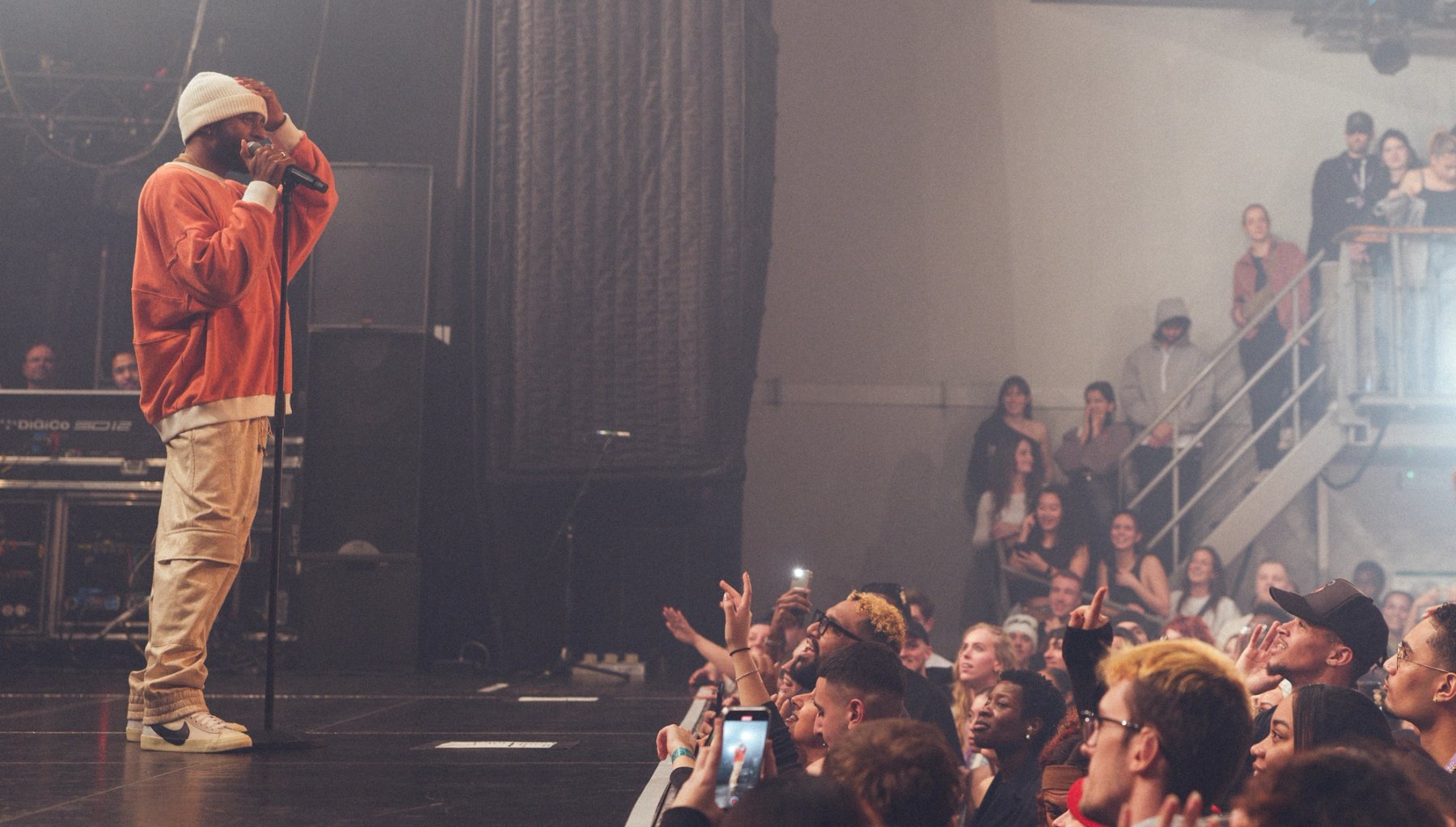
The smaller halls work differently, and Upstairs is the one to understand. It has a raised tiered section at the back where people sit. That is what it is for: somewhere to take the weight off and watch for a while, which not every small room offers. For a photographer it is also free elevation. You can move between the floor and the tier and come away with two genuinely different perspectives from one set, which is hard to do in a room that size.
We shot Kenya Grace in Upstairs on 22 October 2023 and Kxllswxtch in the same room three nights later. Two very different sets, and in both cases the tier was what saved the second half of the shoot, once the floor in front of the stage had filled in and stopped being negotiable.
The fourth room is the Rabozaal, reached over the small bridge to the left of the main entrance rather than through the building. Worth knowing before you arrive, because it is the one room you cannot wander into from inside.
The last layout point is a scheduling one. Because several halls run at once, there are often multiple concerts in the building on the same night. With a bit of luck and a bit of planning, you can shoot two or three artists in one visit. We have done it more than once. On 16 February 2024 we came away with three sets from one evening. Check the full programme before you go, not just the show you came for.
October is the extreme version of this. Melkweg is an ADE venue, and during Amsterdam Dance Event the building runs at full capacity for five days. We shot Paul van Dyk's AAA set in the Rabozaal during ADE 2022, and Kenya Grace in Upstairs on the closing night of ADE 2023. If you are planning one week in Amsterdam, that is the week.
Lighting conditions and camera settings
Settings are personal, and they depend as much on the body in your hands as on the room. So take these as ours rather than as the answer.
On the Sony we try not to go above ISO 1600, and at Melkweg that is usually achievable. Aperture sits somewhere between f/1.8 and f/4.5. For close-ups we go down to the wide end, which is where we like it most: it is what puts the detail in the face and lets the rest of the room fall away. When a room is darker we open up rather than push the ISO higher.
On the Leica the calculation changes. There you can let the ISO climb without worrying about it, and it often does something good to the colours rather than something you have to fix later. Same building, same night, different ceiling.
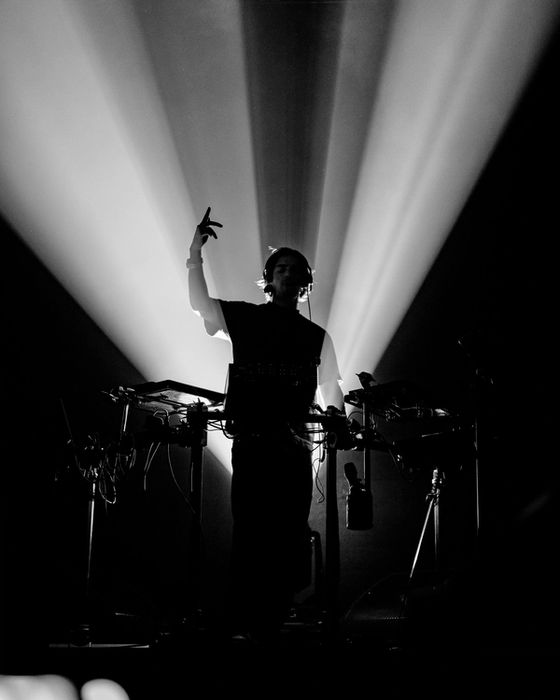
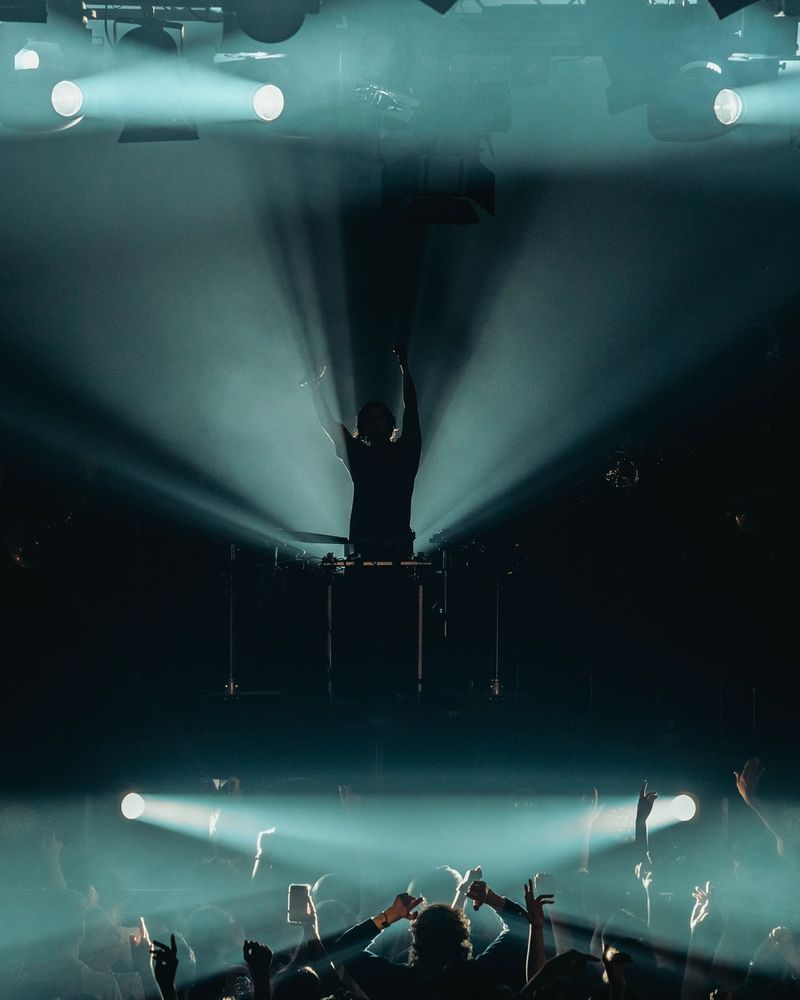
The other half of this is that the lighting here is not one thing. Melkweg's rigs vary by hall and by production, and some shows arrive with a light design worth photographing in its own right. Apashe in February 2024 was one of those. The show was built around the lighting, and framing wide enough to keep the rig and the crowd in the picture gave us better frames than any tight portrait from that night would have.
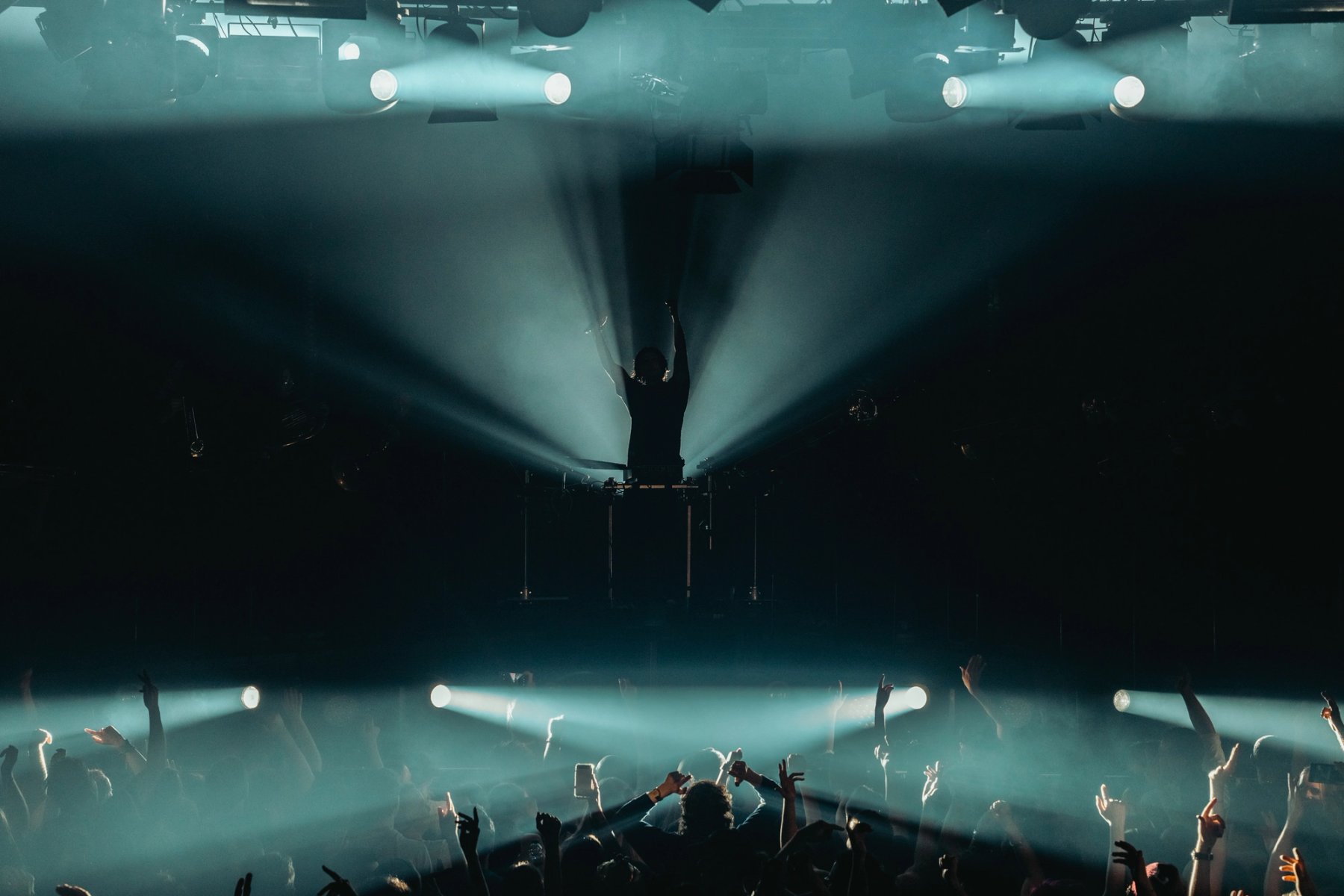
That is the general rule in this building. When the production is good, do not crop it out.
Best lenses for shooting at Melkweg
Two lenses cover almost everything here, and the reason is the missing pit.
70-200mm. This is the one that saves the night. Without a pit you cannot count on being close, and on a busy show you may end up further back than you planned. The 70-200 means a bad position is still a usable position. We take it every time.
24-70mm, or a 50mm prime. For everything the long one cannot do. Wide frames that include the crowd, the room and the light rig. Since you are standing in the audience rather than in front of it, the crowd is right there in the frame with you, and that is an advantage worth using rather than avoiding. These are the shots that say Melkweg rather than any dark room anywhere.
If you are carrying one body, the 70-200 goes on it and the wide one lives in the bag for the last two songs.
Access and accreditation at Melkweg
It is not always easy to get access to Melkweg as a photographer.
Melkweg works with its own photo team, and that team is good. It makes sense for the venue: the same photographers across the programme means a consistent archive, and it means the people in the building know each other. So an outside request is a request to join something that already works, rather than to fill a gap.
In practice there are two routes in. The first is to come attached to a publication, and generally a recognised one. The second is to come through the artist or their management, which in our experience is the more reliable of the two, especially for touring acts where the photo pass is the artist's to give rather than the venue's.
This is not specific to Melkweg either. Having shot in both cities, Amsterdam is harder to get into than Berlin across the board. Berlin rooms of a comparable size will often say yes to a photographer with a decent portfolio and a reason to be there. Amsterdam asks who sent you. If you are moving between the two, budget more lead time here.
Neither route is quick. Ask early, ask through the right party, and be specific about what the pictures are for.
Nearby: the rest of the neighbourhood
Melkweg sits just off Leidseplein, which is the densest live music corner in the city. Paradiso is a five-minute walk away, close enough that on a good night you could shoot in both buildings, and we have covered shows in both.
If you are working out where else to go in the city, we wrote a full guide to where to see live music in Amsterdam, venue by venue.
Also on TREACLE
Field Notes
Where to see live music in Amsterdam: a guide to the rooms
A church, a dairy factory, a horse-tram depot and a former film academy. The Amsterdam rooms worth knowing, what plays in them, and what to expect when you walk in.
Field Notes
ADE 2026: what a day actually looks like
The 30th Amsterdam Dance Event runs 21 to 25 October, from an aquarium at nine in the morning to hundreds of club nights. Here is the shape of a day.
From the Pit
Nobody owes you a photo pass. Here is how to ask for one anyway.
Who actually decides, what they want to see, why the answer is often no, and what to do when it is.
TREACLE